
Pedagogy for the Multi-Dimensional Mind: Balancing Algorithmic Rigor with Human Empathy
"Check the loop bounds. Look at the data types. Verify the CAN bus traffic."
When a high-stakes software system is throwing timeout errors or a hardware subsystem is acting erratic in the middle of a high-pressure integration cycle, our technical brains immediately jump to the logic. We want to debug the syntax, optimize the performance, and isolate the bug.
But if the person sitting next to you—whether they are a high school student staring at an FRC robotics pit or a junior developer pushing their first production commit—is quietly panicking, feeling isolated, or questioning if they even belong in the room, your technical debugging is entirely useless.
Before a developer can learn to write clean loops, optimize complex data streams, or architect real-time control code, they have to feel secure in their environment. Teaching programming isn’t a syntax problem; it’s a human problem. If we want to build a healthier, more inclusive, and higher-performing technical culture, we have to design curricula and onboarding tracks that validate emotional experiences alongside computational logic.
🧱 The Foundational Layer: Maslow’s Hierarchy in the IDE
My perspective on software engineering pedagogy didn’t come from a standard corporate training manual. Before I pivoted into software roles at places like Boeing and IBM, and before I jumped into graduate computer science research in AI and machine learning, I worked in education. Specifically, special education.
During that time, I worked across the spectrum—from schools in wealthy, high-income areas to those in deeply impoverished communities. That experience taught me a psychological truth that has stuck with me well into my career change: People have to have their lower-level needs met before they can grow, learn, and excel.
If you’ve never seen Maslow’s Hierarchy of Needs, here’s the quick refresher. At the base of the pyramid are your physiological and safety needs. As you move up, you reach belonging, esteem, and finally, self-actualization.
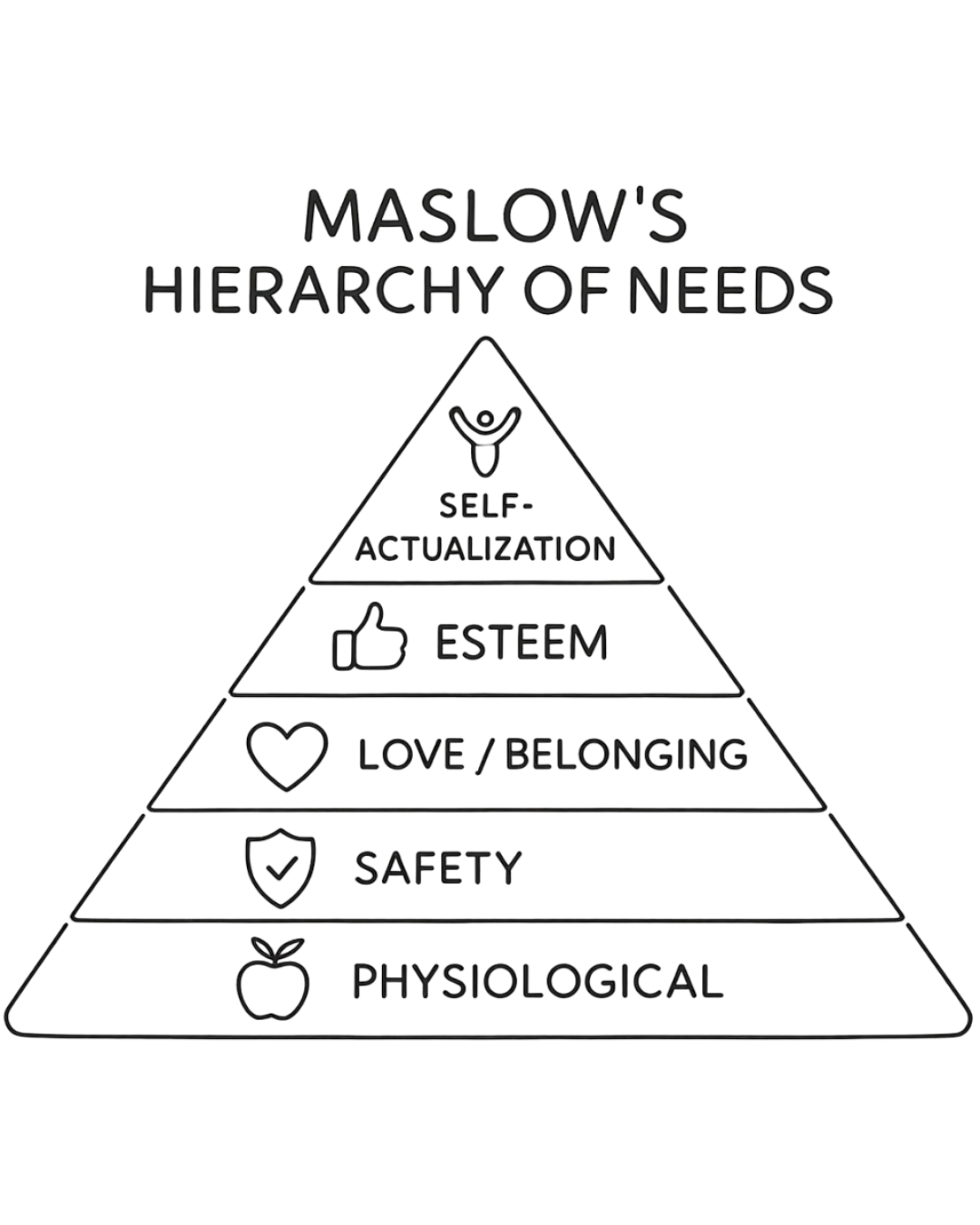
Students, junior engineers, and new team members are people first. They have human needs and human wants. If you need someone to master a complex technical concept, you have to actively bridge any needs gaps they have first.
Yes, this looks wildly different depending on your environment. When I’m mentoring high school robotics teams in underfunded areas, meeting lower-level needs might literally mean ensuring the team provides dinner at every single meeting. You can’t expect a student to comprehend the underlying principles of PID loops if they are staring at an IDE on an empty stomach. For some of those students, simply providing a physically safe, predictable place to be fills an unmet lower-level need.
When onboarding a junior software engineer to an enterprise codebase, filling those needs looks different, but the psychology is identical. It looks like providing comprehensive, crystal-clear onboarding documentation and interactive environment setup guides so they aren't left stranded. It means eradicating the toxic "sink or swim" mentality that forces newcomers to guess what success looks like.
Across every single context, one thing remains absolutely consistent: People constantly need a psychologically safe place before they can learn, grow, and thrive. ---
🛑 Dismantling Gatekeeping Through Radical Readability
While never calling someone names or being demeaning is a baseline start, it isn’t actually enough to create psychological safety. True safety happens when people feel seen, accepted, and met exactly where they are. In environments where struggling with a difficult technical concept doesn’t automatically make you a failure, people don't just get by—they thrive.
So how does this play a role when we design lessons or structure engineering teams?
Before you expect anyone to perform at their absolute best, you have to audit their environment. Mistakes need to be treated simply as data points—not as sudden risks to someone's inherent value or intelligence. Emotional safety cannot be an afterthought or a slide in an annual HR presentation; it has to be intertwined into the very code we write and the way we teach.
In technical spaces, gatekeeping often happens through intentional, artificial complexity. We see it in cryptic variable names, undocumented legacy workflows, and syntax taught in complete isolation. This approach rewards people who already have prior access or economic privilege, while alienating non-traditional learners or generalists who balance analytical math with human empathy.
When I teach or design a technical curriculum—whether it's breaking down real-time Java code for a robot or scaling an algorithm—I always advocate for a systems-first approach. We don't trace syntax in a vacuum. We anchor the logic directly to the physical system, the mechanical constraints, and the real-world impact. By tying abstract theory to tangible reality, we eliminate the intimidating guessing game and allow non-traditional students to safely bridge the gap to writing high-stakes control code.
🛠️ Implementing Empathy-Driven Onboarding
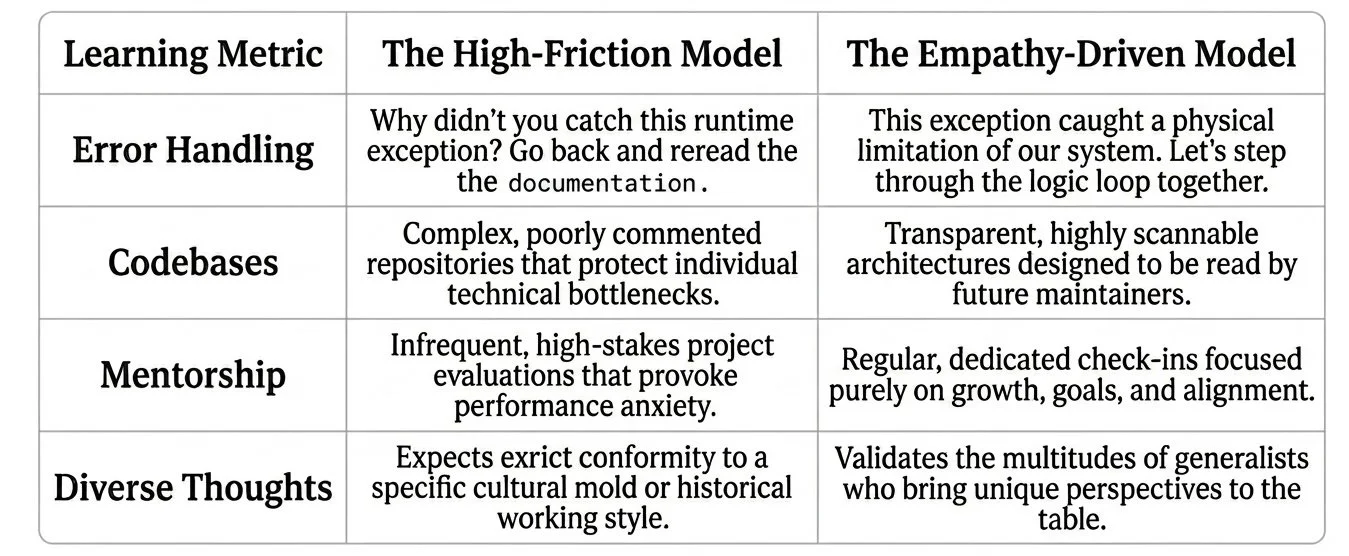
To transform these ideas from high-level philosophy into an actionable roadmap, we have to look closely at our daily habits. Here is a side-by-side comparison of how a traditional, high-friction tech culture approaches learning spaces versus how an empathy-driven pedagogy restructures them:
💡 The Ripple Effect: Why Diverse Thought Authors Better Systems
Why does any of this matter? Can't we just find a steady stream of engineers or students who will put up with whatever grueling, high-friction environment we give them?
Perhaps you can. But you will never get their absolute best work if you refuse to consider their human needs.
Furthermore, students and engineers who are underrepresented in tech are even more likely to be deeply, negatively affected by a lack of emotional safety. This is because the engineering setting itself often brings an inherent level of feeling emotionally unsafe. Walking into a lab or an integration room and realizing you are the only one, or one of only a few "like you," can be incredibly isolating. It magnifies every seemingly small mistake into a massive internal crisis.
But here is the truth: everything we build is undeniably better when we have more diverse thought going into it. We don't get better software by building exclusive clubs; we get better software by inviting different perspectives to solve complex systemic problems. We make that inclusive world we want to see—one where everyone genuinely feels like they have a seat at the table—by the quiet, daily micro-actions of leading with empathy and emotional safety. We create healthier, happier, and ultimately higher-performing learning and workspaces when people are seen as whole humans first, and their needs are respected.
🔌 System Check
Confirming Your Pedagogical Foundation
Before you deploy your next instructional unit, open a pull request, or kick off an onboarding track, verify these parameters:
The Error Guardrail Is Active: Are errors in your space treated as collaborative debugging data rather than individual intelligence failures?
Onboarding Docs Are Explicit: Do you have an interactive, clear setup guide that respects a newcomer's time and reduces isolation?
Lower-Level Needs Are Audited: Have you checked for hidden friction points (hunger, sensory overwhelm, financial barriers) that block your team's focus?
Syntax Is Contextualized: Are you teaching abstract concepts in isolation, or are your lessons anchored in physical systems and real-world impacts?
Are you trying to structure a technical curriculum or reshape the onboarding culture on your engineering team? What strategies have you found that help developers feel secure enough to take real technical risks?
I'd love to hear your thoughts—connect with me on LinkedIn or follow @code_with_kate for more real talk on navigating tech, education, and career growth.
❓ Single Relevant Follow-Up
When you reflect on your current engineering team, codebase, or student subteam, what is the single biggest "informal barrier" or piece of hidden cultural friction that makes it difficult for a newcomer to feel completely secure and ready to learn?
