
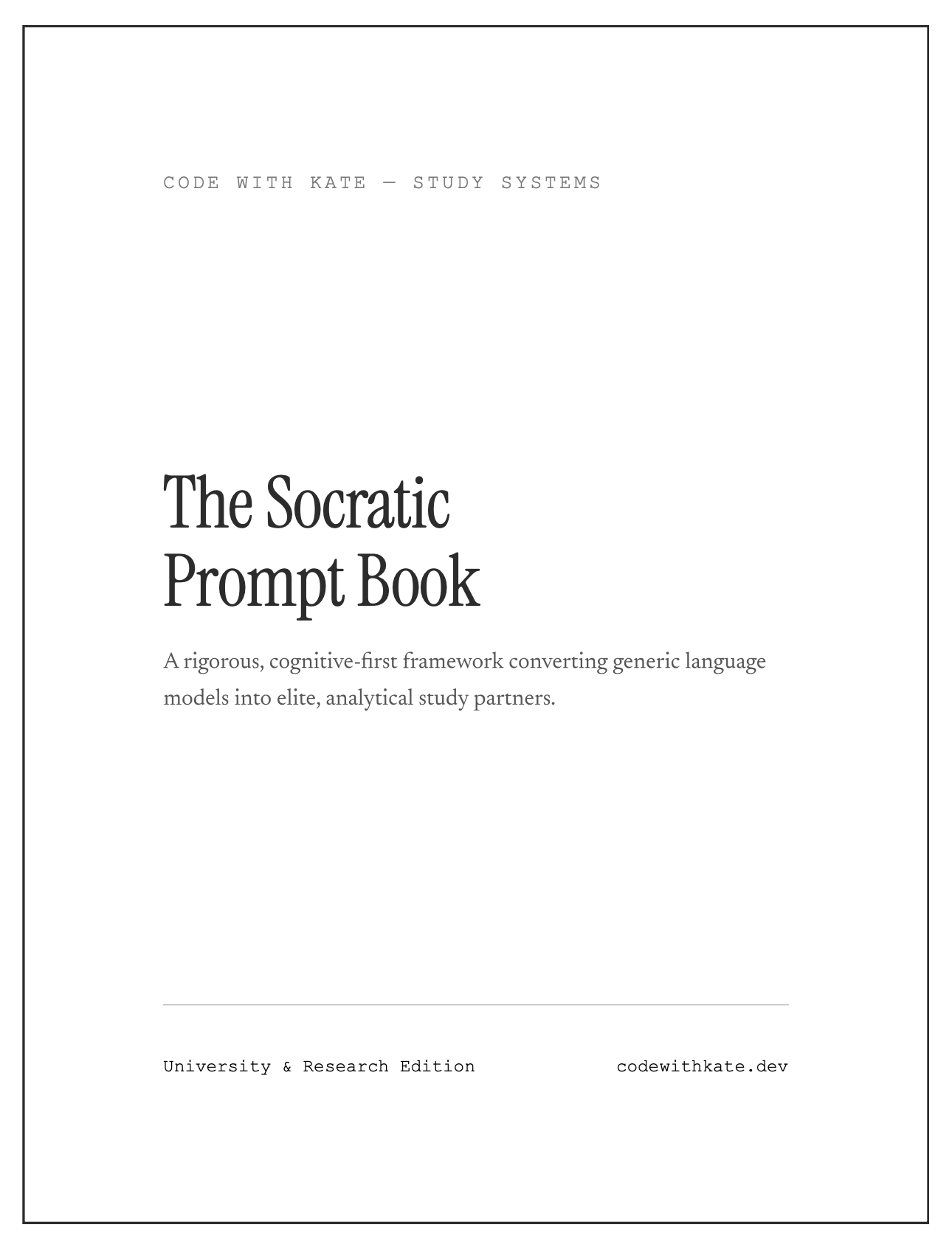
The Socratic Prompt Book: A Rigorous, Cognitive-First Guide to Studying with LLMs
Stop using AI as a copy-paste answer generator. Start studying like a systems architect.
When you are navigating high-density computer science tracks, advanced algorithms, or performance-critical engineering courses, letting an LLM just hand you a solution is academic sabotage. Out-of-the-box, language models default to generic information dumps, leaving you vulnerable when faced with complex runtime bugs, platform memory constraints, or intensive technical interviews.
The Socratic Prompt Book is a comprehensive, research-backed digital guide containing 7 highly engineered system prompts that transform Claude, Gemini, or ChatGPT into an elite academic co-pilot.
Presented in a beautiful, print-ready PDF designed with the signature minimal aesthetic of the Code with Kate brand, this layout uses clean editorial typography (Instrument Serif and Newsreader) and a library-lit palette to ease eye strain during late-night study sessions.
What’s Inside the Master Guide:
Engine 01: The Socratic Seminar Co-Pilot — Implements a strict, one-question-at-a-time cadence that blocks the AI from giving away answers and forces you to articulate state transitions in plain English first.
Engine 02: The Feynman Analogy Demystifier — Guides the model to construct human-scale, physical analogies (like library filing corridors or automated assembly lines) to ground invisible code properties without stripping the technical rigor.
Engine 03: Anki Spaced Repetition Builder — Instantly parses raw textbook documentation or slide scans into markdown tables optimized for rapid CSV import into Anki decks.
Engine 04: Physical-to-Software Mapping Guide — Traces raw hardware constraints (such as CPU cache lines or thread latency bounds) directly down to explicit language APIs and safe implementations.
Engine 05: Socratic Duck Debugger — Configures a supportive senior tech-lead persona that guides you through thread contention, index edge cases, or pointer refactoring without writing the fix for you.
Engine 06: Adaptive Viva Defense Examiner — Simulates a grueling oral exam panel or thesis review, scoring your logical defenses from 1–10 and dynamically dialing up technical difficulty based on where your assumptions slip.
Engine 07: Code Rubric & Pattern Auditor — Acts as a demanding grading TA, auditing your complete code files for algorithmic execution limits ($O(N)$ bounds) and structural design anti-patterns before submission.
Premium PDF Features:
Interactive Copy Blocks: Fully optimized for seamless copying and pasting directly from your tablet, laptop, or desktop straight into your LLM terminal.
Print-Optimized Stylesheet Formatting: Includes a built-in booklet design with a professional, minimalist cover page—allowing you to print it directly onto paper to create a physical, keep-forever technical study journal.
Deep Academic Context: Hardcoded with graduate-level concurrency defaults (C++11 atomic operations and memory fences) to demonstrate how to force maximum depth, absolute rigor, and structural edge-case analysis out of generic models.
Claim your multitudes, master your runtime systems, and engineer with empathy.
Format: Digital Download (High-Resolution, Printable PDF Document).
Stop using AI as a copy-paste answer generator. Start studying like a systems architect.
When you are navigating high-density computer science tracks, advanced algorithms, or performance-critical engineering courses, letting an LLM just hand you a solution is academic sabotage. Out-of-the-box, language models default to generic information dumps, leaving you vulnerable when faced with complex runtime bugs, platform memory constraints, or intensive technical interviews.
The Socratic Prompt Book is a comprehensive, research-backed digital guide containing 7 highly engineered system prompts that transform Claude, Gemini, or ChatGPT into an elite academic co-pilot.
Presented in a beautiful, print-ready PDF designed with the signature minimal aesthetic of the Code with Kate brand, this layout uses clean editorial typography (Instrument Serif and Newsreader) and a library-lit palette to ease eye strain during late-night study sessions.
What’s Inside the Master Guide:
Engine 01: The Socratic Seminar Co-Pilot — Implements a strict, one-question-at-a-time cadence that blocks the AI from giving away answers and forces you to articulate state transitions in plain English first.
Engine 02: The Feynman Analogy Demystifier — Guides the model to construct human-scale, physical analogies (like library filing corridors or automated assembly lines) to ground invisible code properties without stripping the technical rigor.
Engine 03: Anki Spaced Repetition Builder — Instantly parses raw textbook documentation or slide scans into markdown tables optimized for rapid CSV import into Anki decks.
Engine 04: Physical-to-Software Mapping Guide — Traces raw hardware constraints (such as CPU cache lines or thread latency bounds) directly down to explicit language APIs and safe implementations.
Engine 05: Socratic Duck Debugger — Configures a supportive senior tech-lead persona that guides you through thread contention, index edge cases, or pointer refactoring without writing the fix for you.
Engine 06: Adaptive Viva Defense Examiner — Simulates a grueling oral exam panel or thesis review, scoring your logical defenses from 1–10 and dynamically dialing up technical difficulty based on where your assumptions slip.
Engine 07: Code Rubric & Pattern Auditor — Acts as a demanding grading TA, auditing your complete code files for algorithmic execution limits ($O(N)$ bounds) and structural design anti-patterns before submission.
Premium PDF Features:
Interactive Copy Blocks: Fully optimized for seamless copying and pasting directly from your tablet, laptop, or desktop straight into your LLM terminal.
Print-Optimized Stylesheet Formatting: Includes a built-in booklet design with a professional, minimalist cover page—allowing you to print it directly onto paper to create a physical, keep-forever technical study journal.
Deep Academic Context: Hardcoded with graduate-level concurrency defaults (C++11 atomic operations and memory fences) to demonstrate how to force maximum depth, absolute rigor, and structural edge-case analysis out of generic models.
Claim your multitudes, master your runtime systems, and engineer with empathy.
Format: Digital Download (High-Resolution, Printable PDF Document).